
Wind Energy Conversion to Hydrogen: The Future of Energy Storage
Wind energy, as one of the abundant renewable energy sources, has become a central focus in the global energy transition efforts. However, one of the main challenges in utilizing wind energy is the fluctuation in production due to weather conditions. To address this, the technology of converting wind energy into hydrogen has emerged as a promising solution. Hydrogen, being the lightest and most abundant element in the universe, holds great potential as an energy storage medium.
The Conversion Process
The process of converting wind energy into hydrogen involves several key stages:
- Electricity Generation: Wind turbines convert the kinetic energy of the wind into mechanical energy, which is then transformed into electrical energy via a generator.
- Water Electrolysis: The electricity generated by the wind turbine is used to split water molecules (H₂O) into hydrogen (H₂) and oxygen (O₂) through a process known as electrolysis. The chemical reaction that occurs is: 2H₂O → 2H₂ + O₂.
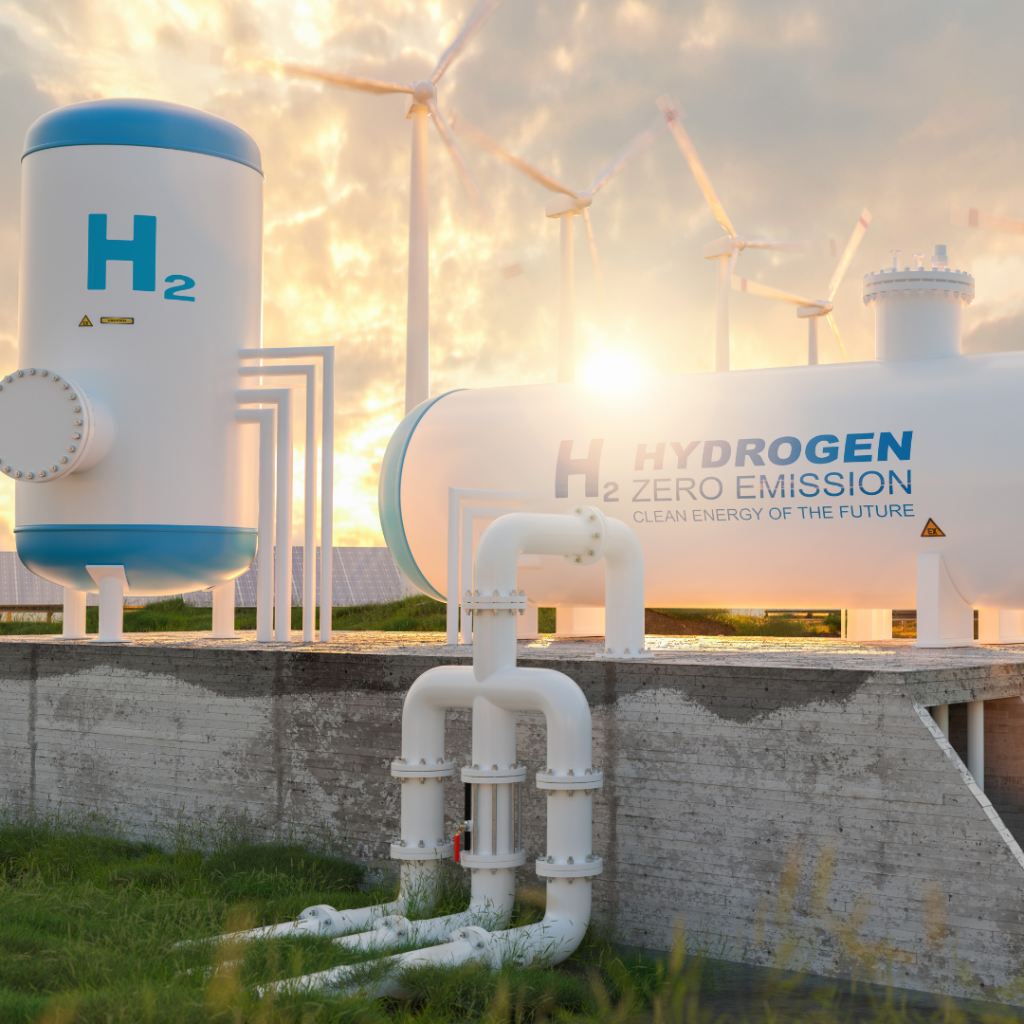
- Hydrogen Storage: The hydrogen produced is then stored in special tanks or containers. Hydrogen can be stored as high-pressure gas, in liquid form at very low temperatures, or as a solid by absorption into certain materials.
Advantages of Storing Energy in the Form of Hydrogen
- High Energy Density: Hydrogen has a high energy density per unit mass, allowing it to store energy in relatively small volumes.
- Flexibility of Use: Hydrogen can be used as fuel for various applications, including power generation, transportation, and heating.
- Long Storage Duration: Hydrogen can be stored for long periods without significant degradation.
Challenges and Technological Development
Although it holds great potential, the technology for converting wind energy to hydrogen still faces several challenges, including:
- Efficiency: The overall efficiency of the conversion process still needs to be improved to reduce energy losses.
- Cost: The production cost of hydrogen remains relatively high, especially for commercial-scale operations.
- Infrastructure: Building infrastructure for hydrogen production, storage, and distribution requires significant investment.
However, ongoing research and development are continuously addressing these challenges. Some promising technological advancements include:
- More Efficient Electrolyzers: Developing electrolyzers with higher efficiency and lower costs.
- Better Storage Materials: Finding safer, more efficient, and high-capacity hydrogen storage materials.
- Integration with Other Renewable Energy Systems: Integrating wind-to-hydrogen conversion systems with other renewable energy systems such as solar and biomass energy.
Converting wind energy to hydrogen offers an attractive solution to address the intermittency challenges associated with wind energy utilization. With the continuous advancement of technology and appropriate policy support, this technology has the potential to become an integral part of a sustainable future energy system.
Source : http://zulfikar.blog.uma.ac.id/2024/01/20/energi-hidrogen/