
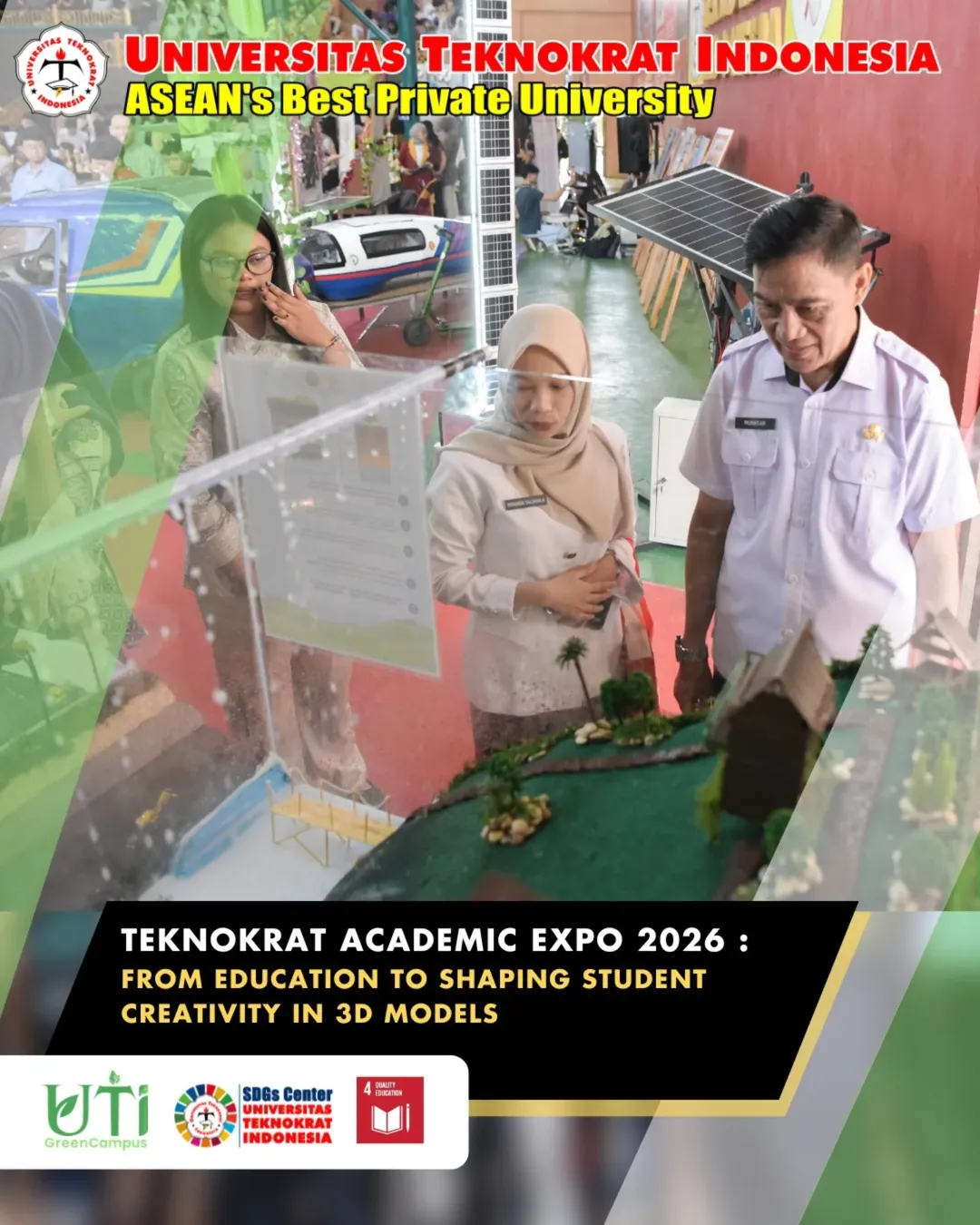
Innovative Learning at Universitas Teknokrat Indonesia: Civil Engineering Students Develop Soil Layer and Hydrological Process Scale Model
Bandar Lampung – Civil Engineering students at Universitas Teknokrat Indonesia continue to demonstrate innovation in applied learning through the development of a detailed scale model that illustrates soil layers and hydrological processes. This educational project was designed as a practical learning medium to simplify complex geotechnical concepts and the natural water cycle, enabling students to better understand the interaction between soil characteristics and water movement.
The creation of the scale model reflects a hands-on learning approach that encourages students to translate theoretical knowledge into tangible visualization. In civil engineering, understanding the relationship between soil properties and hydrological dynamics is crucial, as both significantly influence the planning, design, and construction of infrastructure such as buildings, highways, bridges, and dams.
This project integrates two fundamental areas of civil engineering study: Soil Mechanics and Hydrology. Through Soil Mechanics, students analyze the physical and mechanical properties of soil, including density, permeability, and bearing capacity—factors that determine the stability and safety of structures built on the ground. Meanwhile, Hydrology focuses on the natural movement of water within the environment, encompassing rainfall patterns, infiltration processes, groundwater flow, and surface runoff.
According to the academic team supervising the project, combining these two disciplines allows students to develop a more holistic understanding of how soil and water systems interact in real-world engineering scenarios.
“By visualizing soil layers and water movement through a scale model, students can more easily grasp complex geotechnical concepts that are often difficult to understand through theory alone,” explained one of the lecturers involved in the project.
The scale model developed by the students presents a detailed cross-sectional representation of underground soil layers. The model includes several strata arranged sequentially, starting from topsoil, followed by clay, sand, and ending with bedrock. Each layer is designed with different colors and textures to provide a realistic depiction of subsurface geological structures.
In addition to illustrating soil stratification, the model also incorporates dynamic simulations of hydrological processes. Water can be poured onto the model surface to demonstrate rainfall infiltration into the soil and the formation of surface runoff. Through this simulation, students are able to observe how water interacts with different soil types, including how permeability and soil composition influence water absorption and flow.
This interactive approach not only enhances students’ conceptual understanding but also strengthens their analytical and problem-solving skills in addressing real engineering challenges. By observing the physical behavior of water within layered soils, students gain insights into issues such as drainage planning, slope stability, groundwater management, and flood mitigation.
The project also reflects Universitas Teknokrat Indonesia’s commitment to promoting experiential learning in engineering education. By combining theoretical instruction with practical demonstrations, the university aims to prepare graduates who are not only academically competent but also capable of applying their knowledge to real-world infrastructure development.
Through innovative learning initiatives such as this scale model project, Civil Engineering students at Universitas Teknokrat Indonesia continue to showcase their creativity, technical competence, and readiness to contribute to sustainable infrastructure solutions in the future.
Other News: Civil Engineering Students of Universitas Teknokrat Indonesia Showcase Dam Scale Model at Academic Expo 2026
Support SDGs: